

East Potomac Golf Links in Washington, D.C., has become the center of one of the most consequential public-golf disputes in the United States. More than 400 trees were removed from the historic course in October 2026, triggering a federal court confrontation over whether the work was part of a legitimate restoration effort or an accelerated step toward President Donald Trump’s proposed championship-course redevelopment. For golfers following the broader sports and recreation landscape, BetOnline user ratings also offer a useful example of how player and consumer feedback increasingly shapes conversations across the wider sports industry, even as East Potomac’s debate remains focused on public access, historic preservation and course design.
The controversy goes well beyond tree removal. East Potomac is a century-old public golf facility with a history tied to course architecture, affordable recreation and the integration of Washington’s public golf system. The National Park Service says the first 18 holes were built between 1918 and 1923 under the direction of renowned architect Walter J. Travis, while the facility later became an important site in the city’s civil rights history. National Park Service
The current dispute raises a question that golf communities across the country may increasingly face: How much can a historic public course change before improving it effectively means replacing what made it public and historic in the first place?
Why East Potomac Golf Links Matters to American Golf
East Potomac is not a typical municipal golf course.
Located on Hains Point in Washington, D.C., the facility sits within East Potomac Park and provides views toward the Potomac River, Washington Monument and surrounding capital landmarks. Its golf history dates to the Golden Age of Golf, when public courses were being developed as part of a broader movement to make recreation more accessible to ordinary Americans.
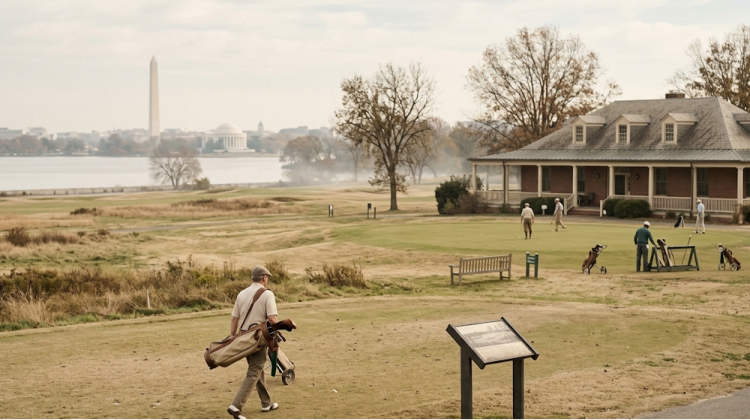
Walter J. Travis designed the original course as a traditional links-style layout. The National Park Service’s historical research describes Travis’s concept as one built around open ground, wind and relatively sparse vegetation rather than the heavily wooded character associated with many modern parkland courses. National Park Service
That distinction is central to the current argument.
The National Park Service’s 2019 cultural landscape report recommended vegetation management at East Potomac to restore elements of the course’s historic links character. According to the agency’s current project documentation, decades of planting and unchecked vegetation changed parts of the property from the open character envisioned by Travis toward a more parkland-style appearance. Park Planning
The agency therefore argues that tree removal is connected to an existing restoration plan rather than being solely a component of Trump’s proposed redevelopment.
The legal challenge centers partly on whether those two explanations can realistically be separated.
More Than 400 Trees Were Removed in October
The immediate controversy escalated dramatically in early October.
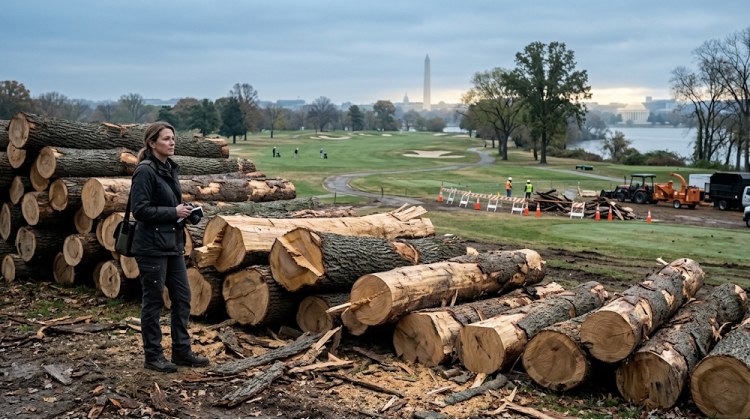
According to court testimony reported October 12, National Park Service crews removed approximately 430 trees on Saturday, October 10, despite previous court concerns about irreversible changes to the historic course. Government filings had initially indicated that 169 trees would be removed in the first phase, followed by another 90, with the potential total reaching 529 trees. The Washington Post
The scale of the work prompted U.S. District Judge Ana C. Reyes to intervene.
On October 13, Reyes extended an order blocking additional tree cutting through October 26 and required the government to provide three business days’ notice before making further irreversible changes to the property. She also ordered National Park Service Director Jessica Bowron and Interior Department deputy chief of staff Gregory Wischer to testify about how the tree-removal plan developed and why the work proceeded so quickly. The Washington Post
The dispute intensified further after Reyes issued a written opinion questioning the administration’s explanation that the cutting was primarily driven by the older 2019 restoration recommendations.
The judge concluded, based on the record available to her, that officials had moved at “breakneck” speed because of the push to advance Trump’s redesign rather than because of a newly urgent tree-management problem. The Washington Post
That distinction could prove significant for the future of East Potomac.
The Tom Fazio Proposal Changes the Conversation
The controversy cannot be separated from the larger redevelopment plan backed by Trump.
Trump has tapped renowned golf architect Tom Fazio to develop a championship-level redesign of East Potomac. The proposed transformation would seek to turn the historic public facility into a course capable of hosting major professional events, according to recent reporting.
Trump announced plans on October 18 indicating that the course could close on November 15 and reopen approximately 15 months later. The proposed redesign would dramatically change portions of the existing park, including recreational spaces and transportation routes that have traditionally served visitors. The Washington Post
Fazio’s involvement immediately elevates the golf-design significance of the project.
A championship course requires different considerations from a recreational municipal facility. Tournament infrastructure, spectator circulation, practice areas, shot values, green complexes, maintenance standards and course length all become important. A redesign intended for major events could also require substantial changes to land use and daily operations.
But that creates a fundamental tension at East Potomac.
The same characteristics that could make the property attractive for elite championship golf are also the characteristics that make it valuable as public golf.
The question is whether the two objectives can coexist.
Public Golf Versus Championship Golf
The National Park Service has historically emphasized affordable public golf at its three Washington courses: East Potomac, Rock Creek and Langston. The agency says National Links Trust manages the courses through a 50-year master lease intended to provide recreational opportunities while addressing deferred maintenance and preserving historically significant features. National Park Service
East Potomac’s significance is especially deep.
The National Park Service records that the course was originally segregated. In 1941, three Black golfers — Asa Williams, George Williams and Cecil R. Shamwell — challenged the discriminatory system by playing a full 18-hole round at East Potomac. The action helped force the integration of Washington’s public golf facilities. National Park Service
That history makes accessibility more than a pricing question.
East Potomac represents an example of public golf being used as a civic institution. Its importance is tied to who can play, who can gather there and how the facility fits into the surrounding public park.
A championship transformation could bring better playing conditions and potentially greater national attention. It could also change the economic and social character of the facility.
What the Tree Dispute Says About Course Architecture
From a golf-design perspective, the tree controversy is more complicated than simply deciding whether trees are good or bad.
Trees can define holes, frame landing zones, provide strategic hazards and create visual separation between fairways. But excessive tree growth can also eliminate intended shot options, block wind and reduce the strategic variety of a links-style course.
The National Park Service’s 2019 documentation specifically argues that East Potomac’s historic character depended on open spaces and limited vegetation. The agency says later growth altered views and playing strategy, particularly on the Blue Course. Park Planning
That means some level of tree management can be consistent with historic preservation.
The difficult question is scale, timing and purpose.
Removing selected vegetation to restore historic sightlines is different from clearing hundreds of trees while a major redevelopment proposal is simultaneously being advanced.
That distinction is now at the heart of the federal case.
Why Public Golf Course Renovations Need Transparency
East Potomac offers a useful case study for golf clubs and municipalities considering major renovations.
Large-scale course projects inevitably involve environmental impacts. Trees may need to be removed, drainage systems changed, bunkers rebuilt and fairways reshaped. Those decisions can dramatically alter a property’s ecological and recreational characteristics.
At a historic public facility, the process becomes even more complicated.
The National Park Service has already conducted extensive historical research into East Potomac, Rock Creek and Langston. All three courses are listed in the National Register of Historic Places, and the agency says the studies are intended to guide preservation, management and public use. National Park Service
The current litigation demonstrates why that documentation matters.
The DC Preservation League and local residents filed their legal challenge in February 2026, arguing that the administration had failed to comply with federal environmental and historic-preservation requirements while pursuing changes at East Potomac. The Washington Post
The court fight therefore isn’t simply about whether a new golf course would be better than the existing one.
It is also about how public golf facilities should be changed when their land carries historical, environmental and recreational significance.
What Could Happen to East Potomac Next?
The immediate future remains uncertain.
Judge Reyes’s temporary restrictions currently prohibit additional tree removal through October 26, while the court examines the government’s actions and the broader redevelopment dispute. The judge has also ordered senior Interior and National Park Service officials to provide testimony about the tree-management process. The Washington Post
At the same time, the Trump administration continues to promote a major redevelopment vision involving Tom Fazio and a championship-caliber course.
Recent reporting indicates that the proposed project could eliminate or significantly alter some existing recreational features around East Potomac Park, raising questions about walking and cycling routes, the historic miniature golf facility and other public uses. The Washington Post
The uncertainty is therefore about more than construction timing.
The eventual legal and administrative decisions could determine whether East Potomac remains primarily a broad public recreation facility, becomes a championship-focused golf destination, or attempts to combine those functions in a substantially different configuration.
The Bigger Lesson for Public Golf
East Potomac Golf Links illustrates why the future of American public golf cannot be measured solely by course ratings, tournament potential or architectural prestige.
A successful public course also has to serve the community that surrounds it.
The facility has been part of Washington’s recreational landscape for more than a century. It has hosted generations of golfers, played a role in the city’s civil rights history and preserved an unusual example of early American public golf architecture.
There is a legitimate architectural argument for restoring elements of Walter Travis’s original links concept. There is also a legitimate golf-development argument for creating a modern championship course in the nation’s capital.
The challenge is determining whether those objectives can be achieved without sacrificing the public character that made East Potomac significant in the first place.
That is why the removal of more than 400 trees has become such a consequential issue. The trees are tangible evidence of a much larger debate about historic preservation, golf-course architecture, environmental review and access to public recreation.
For golf course operators and communities watching from elsewhere in the United States, East Potomac could become an important precedent. As aging municipal courses receive pressure for modernization, redevelopment and higher-value uses, the decisions made in Washington could influence how communities balance championship ambitions with affordability, heritage and everyday access.
For now, the future of one of America’s most historically significant public golf properties remains tied to a courtroom as much as it is to the drawing board.