
Presidents Cup 2026 is scheduled for September 22-27, 2026, at Medinah Country Club, with match play set for September 24-27, according to the PGA Tour’s Medinah preview. As of September 21, 2026, the event has not yet started, so the safest reading is a setup-based preview rather than a results analysis. From a course design standpoint, the central question is not whether Medinah No. 3 is long enough. It is how the post-redesign scale, routing, and green complexes convert match-play pressure into clear strategic choices.
Course No. 3 has already carried major championship and team-event weight, including the 2012 Ryder Cup, multiple PGA Championships, U.S. Opens, and the 2019 BMW Championship. That context matters, but it should not be treated as a fixed template for this edition. The 2024 OCM redesign changed several visual and strategic cues: larger greens, bigger-scale bunkers, wider fairways, more open vistas, and broad areas of long fescue rough are listed in the official course overview. Those features can invite bolder drives while still asking for disciplined approach play.
Presidents Cup 2026 Course Setup
What The Redesign Changes
The first design reading is that width should not be mistaken for ease. Wider fairways can reduce the penalty for a slightly offline tee shot, but they can also create a wider menu of angles. In match play, that matters because a player or side does not always need the safest line; sometimes the better choice is the line that opens the green or puts pressure on an opponent. For Presidents Cup 2026, the wider corridors may let elite drivers choose between conservative placement and more aggressive angles into pins.
The larger greens are just as important. Bigger targets can raise the percentage of approaches that find putting surfaces, yet they can leave longer putts and awkward internal contours if the approach enters from the wrong side. The research points to precision on approach shots and strong putting under pressure as likely differentiators. That is a reasonable course-design inference, provided it is kept narrow: large greens do not automatically favor every strong ball-striker. They tend to reward players who control distance, spin, and entry angle.
Why Width Does Not Remove Difficulty
The setup includes broad areas of long fescue rough. That combination of width and fescue can create a useful match-play tension. Players may see inviting landing areas from the tee, but the penalty for missing outside the prepared corridor can still be severe enough to shape decision-making. A drive that finishes in fescue may not always lead to a lost hole, yet it can reduce control into large greens, especially if a front, back, or side section is the true target.
Medinah’s Gold tee figures supplied in the research show a par-72 course measuring 7,564 yards with a 76.8 rating and 143 slope. Those numbers support the plain point that the championship layout has enough scale to test long-game quality. Lower tee combinations are shorter and carry more forgiving slope figures, but tournament setup choices will be the meaningful factor during the event.
Tee Yardage And Match-Play Friction
In four-ball, one partner can often take on a more demanding tee line if the other has found position. In foursomes, the same decision becomes more severe because the partner must play the next shot. That difference can make the same hole feel very different across the week. The best setup question is not simply whether a tee is back or forward. It is whether the tee, fairway angle, fescue line, and green section create a fair choice with a visible reward.
Routing, Spectators, And Closing-Hole Pressure
Rerouting For More Decisive Late Holes
The research notes that the traditional holes have been renumbered or rerouted so that holes 15-18 have a better chance to matter late in matches. One example given is that the prior Hole 5 becomes the first hole in the Presidents Cup routing, while Member No. 1 becomes Presidents Cup No. 15. That is more than a presentation choice. In match play, routing can decide which architectural questions players face while a match is still undecided.
The reason is supported by a striking event-pattern note in the research: previous Presidents Cups averaged less than 40% of matches reaching the 17th hole. If many matches end before the last two holes, the closing stretch can be underused competitively. Rerouting is a direct response to that issue. It does not guarantee late drama, but it places more consequential holes where more matches are likely to encounter them.
Broadcast Logic And Player Choice
There is also a spectator and broadcast logic to the routing. More open vistas can help viewers see golf shots develop, and decisive late holes can concentrate attention without changing the fundamentals of match play. Readers interested in fan movement and site flow can compare this with our Medinah visitor notes. Additionally, those exploring event coverage in this network can find a related site, Banat Zayed, which also covers aspects of golf course design and strategy, focusing on Medinah’s unique challenges.
For players, routing also affects emotional pacing. A side that is one down with four to play needs holes that offer chances without turning into coin flips. The available research does not provide hole-by-hole yardages for the Presidents Cup routing, so any claim about a specific closing-hole scoring pattern would be premature. What can be said is narrower: the routing has been adjusted to bring the final stretch into play more often.
Strategic Skills That Should Travel
Presidents Cup 2026 Tee Strategy
Elite driving off the tee is identified in the research as a skill likely to matter after the redesign. At Presidents Cup 2026, that should mean more than raw distance. A useful tee strategy will pair length with angle selection. The best drives may not always be the longest drives; they may be the drives that leave an approach from the correct side of a wide fairway, away from fescue and with a clean view into the chosen green section.
Match play can push players toward more aggressive lines than stroke play would. That is not reckless by default. If an opponent is out of position, a safer center-line drive may be enough. If an opponent is already in ideal position, a player may need to attack a stronger angle. The redesign’s wider fairways appear to allow those distinctions, while the fescue provides a boundary against careless aggression.
Approaches Into Larger Greens
The larger greens may create a second layer of strategy. A player can hit the green and still fail to gain much if the ball finishes on the wrong tier or far from the hole. That is especially relevant in four-ball, where birdie looks are often needed to win holes, and in singles, where lag putting under pressure can keep a match from slipping away.
Approach precision should be judged in relation to the day’s hole locations. If pins are set near edges or over bunker lines, the wider fairway angle chosen from the tee may become decisive. If pins are more central, distance control and putting pace may matter more than firing at a flag. Without confirmed daily setup sheets, the sensible reading is conditional: Medinah’s redesigned greens expand the target, but they do not remove the need to place the ball.
Putting And Partner Fit
Putting under pressure is listed in the research as a likely differentiator. On larger greens, that can show up in two ways: converting makeable birdie putts and avoiding three-putt losses from long range. Team formats intensify that issue because one player’s pace control can protect a side while a partner takes a more assertive line.
- Four-ball: one player can attack pins or putts while the partner protects par.
- Foursomes: tee-shot placement must account for the partner’s preferred approach distances and shot shapes.
- Singles: the player’s own tolerance for risk becomes clearer because there is no partner to cover a mistake.
Team Format And Course Management
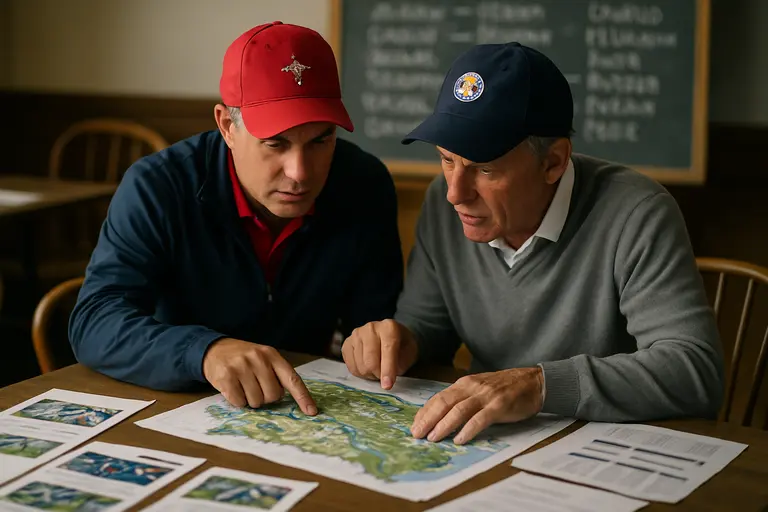
Pairing Decisions Under Match Play
The research states that the competition has 30 total matches across four days, using four-ball, foursomes, and 12 Sunday singles matches. It also states that each side has 12 players, made up of six automatic qualifiers and six captain’s picks. Those format details matter to course setup because Medinah will not ask the same question in every session.
In foursomes, a captain may value complementary driving and approach profiles because the players alternate shots. A long but less accurate driver paired with a precise iron player may work on some holes, but the fescue and large greens could magnify any weak link. In four-ball, a pairing can tolerate more contrast: one steady player and one aggressive player may create enough chances while limiting conceded holes.
Historical Weight Without Overreading It
The research notes that the United States had won 13 of 15 Presidents Cups before 2026, with one International win in 1998 and one tie in 2003. That record is part of the event context, but it should not be used as a shortcut for predicting individual matches at Medinah. Course setup, pairings, daily conditions, and putting performance can compress apparent gaps over 18-hole match-play segments.
Medinah’s past as a championship venue adds public expectation, yet the redesigned Course No. 3 should be evaluated on its present setup. The better analytical stance is to separate venue reputation from the actual questions players face: tee angle, fescue avoidance, approach placement, and putting speed.
Medinah Presidents Cup 2026 Reading
The strongest supported read is that Medinah No. 3 has been shaped to produce visible choices rather than a single correct style. Wider fairways and larger greens can encourage aggression, but bigger bunkers, fescue, and demanding green placement keep discipline in the frame. The rerouting is aimed at making the late holes more relevant, a practical response to the low share of past matches reaching the 17th.
If Presidents Cup 2026 produces strong golf at Medinah, it will likely be because the setup lets match play breathe: enough width for elite players to take on lines, enough penalty to make misses matter, and enough green complexity to reward approach control. That is the course-design balance to watch once matches begin on September 24, 2026.